← → or space · click to advance · P to print
SLU Dermatology · Cosmetics Journal Club · November 2026

To click or not to click: does injection depth change what forehead toxin does?

Davidovic K, Melnikov DV, Frank K, Gavril D, Green JB, Freytag DL, Heisinger S, Pavicic T, Gold MH, Cotofana S. To click or not to click — The importance of understanding the layers of the forehead when injecting neuromodulators — A clinical, prospective, interventional, split‑face study. J Cosmet Dermatol. 2021;20(5):1385‑1392. doi:10.1111/jocd.13875 · PMID 33251687
Presented by Faisal Ahmad, MD · PGY‑4 · Cosmetics rotation
Faculty: Dr. Fehlman · Dr. Shaikh

The question

Why this paper

Same product, same units, same injection points. If the only thing you change is how deep the needle goes, does the forehead respond differently?

  • Neuromodulator injection is the most common non‑surgical aesthetic procedure in the US (1.7 million procedures in 2019 per The Aesthetic Society).
  • The forehead is the one area where we routinely under‑treat on purpose to protect brow position.
  • Two earlier studies said intradermal placement is "safer" (fewer brow drops). Nobody had explained why anatomically, or measured whether it is also weaker.

What the authors set out to do

  • Split‑face: one side superficial, the other deep, in the same patient.
  • Relate the result to the fascial layers of the forehead (the Cotofana anatomy lab's recurring theme).
  • Outcome: forehead line severity at rest and at maximal frontalis contraction, day 14 and day 30.

Self‑funded by the authors. No industry sponsor.

Davidovic et al. J Cosmet Dermatol 2021Introduction
Part 1

Background anatomy

The forehead is not one layer of muscle under skin. It is a sandwich with two fascial sheets, and they matter for where fluid goes.

The layers of the forehead

Anatomy
Skin (epidermis + dermis) Subcutaneous (superficial) fat Suprafrontalis fascia Frontalis muscle Subfrontalis fascia ← the "click" Retrofrontalis fat /loose areolar tissue Periosteum Frontal bone SUPERFICIAL 45°, 30G 8 mm · visible bleb · no click product sits above an intact suprafrontalis fascia DEEP perpendicular, to bone · "click" = subfrontalis fascia fluid tracks retrograde up the canal into the muscle ≈ 4 mm total
Schematic (not to scale). Both fasciae are continuations of the galea aponeurotica. Total forehead soft tissue in this cohort: 4.01 ± 0.8 mm by ultrasound (Bravo et al. 2022 measured 4.18 ± 0.7 mm in 85 patients).

Why the fascia matters

  • The suprafrontalis fascia links frontalis to the dermis through retinacula cutis. That is how contraction prints a line on the skin.
  • The subfrontalis fascia is thick. Perforating it is what you hear and feel as the click.
  • Toxin is essentially water. Where it ends up is governed by the canal the needle makes and the sheets it does or does not cross.

Working definitions in this paper

  • Superficial = superficial fatty layer, subdermal bleb. Not strictly intradermal.
  • Deep = supraperiosteal plane, needle on bone.
Cotofana et al. PRS 2017 (forehead compartments) · Bravo et al. JCD 2022 (ultrasound thickness)Anatomy

What was already known

Prior evidence

Frontalis moves two ways

Cotofana et al. PRS 2020, n = 27, skin‑vector analysis

  • Lower forehead skin moves up (brow elevator segment); upper forehead skin moves down (hairline depressor).
  • They meet at the line of convergence (C‑line): ~61% of forehead height, usually the 2nd horizontal line from the top. Same in men, women, all ethnicities.
  • Suggestion: treat above the C‑line freely; go light and superficial below it to spare the brow.

Intradermal is "safer"

Jun et al. Ann Dermatol 2018 · split‑face, n = 3, 24 wk

  • Same wrinkle improvement, same time to peak effect.
  • Brow sat lower on the intramuscular side for all 3 patients, with more heaviness.

Kim, Lim, Choi Dermatol Surg 2020 · 15 intradermal vs 14 intramuscular women, 8 U total

  • Same antiwrinkle effect and duration; brow lowered at weeks 2 to 4 only in the intramuscular group.
  • Intradermal injection was more painful.

The gap

  • Both "safer" studies read the preserved brow as fewer adverse events.
  • Neither asked whether the superficial side was simply less effective at paralyzing frontalis, nor tied the result to the fascial anatomy.
  • No one had compared superficial vs supraperiosteal placement head to head with contraction‑state grading.
PMIDs 32332530 · 30065587 · 32205751Background
Part 2

Methods

Fourteen foreheads, each its own control.

Design, patients, product

Methods

Design

  • Prospective, interventional, split‑face; side randomly assigned. Single injector (K.D., Belgrade).
  • Rated at baseline, day 14 and day 30.
  • Glabella deliberately not treated (would confound frontalis readout).

Patients (n = 14)

  • Mean age 35.7 ± 7.8 y · BMI 21.9 ± 3.0 · Fitzpatrick I‑III.
  • Wavy lines 64%, straight 36%.
  • Excluded: upper‑face toxin within 6 months, any prior forehead filler, forehead trauma or surgery, visible asymmetry.

Product and dose

  • AbobotulinumtoxinA (Dysport), 500 U reconstituted in 2.0 mL.
  • 25 to 30 Dysport units per forehead (mean 25.7 U), i.e. roughly 8 to 12 Botox‑equivalent units. Same dose both sides.
  • 8 points, 4 per side, upper forehead, two rows.

Superficial side

  • 30G 8 mm needle, 45° entry.
  • Endpoint: visible bleb, no click.
  • Ultrasound confirmed product in subcutaneous fat.

Deep side

  • Perpendicular, advance to bone contact.
  • Endpoint: audible/tactile click (subfrontalis fascia), no bleb.
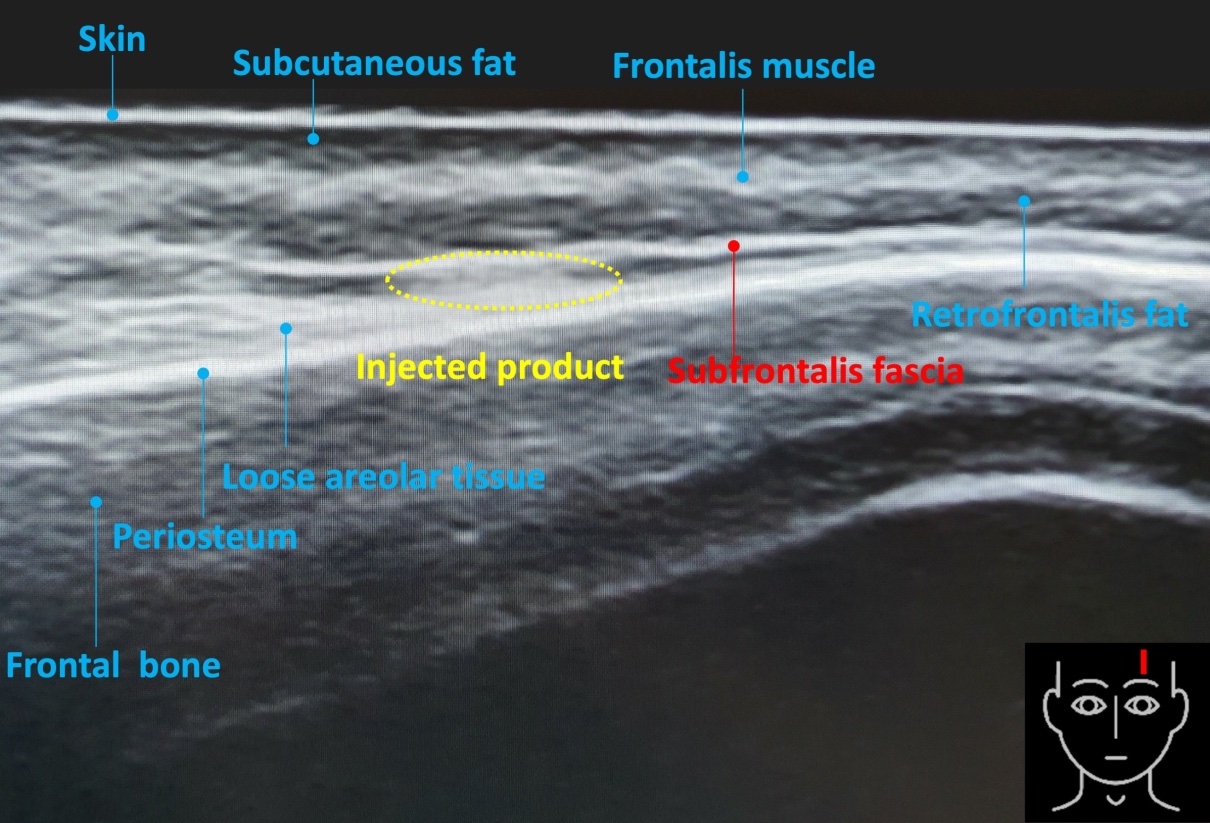
  • Ultrasound confirmed supraperiosteal product.
Davidovic et al. 2021 · Material and MethodsMethods

Injection map and outcome measures

Methods

Primary outcome

  • Horizontal forehead line severity, Flynn 0‑4 scale (0 none, 1 mild, 2 moderate, 3 severe, 4 very severe).
  • Graded separately at rest and at maximal frontalis contraction.

Raters

  • Treating physician (unblinded, live).
  • Two independent raters blinded to depth, grading photographs.
  • Agreement reported as ICC (two‑way mixed, absolute agreement).

Other

  • Ultrasound (4.5‑18 MHz linear probe) measured forehead thickness at the injection site, probe "floating" in gel.
  • Wilcoxon signed‑rank for paired sides. Significance at p ≤ 0.05.
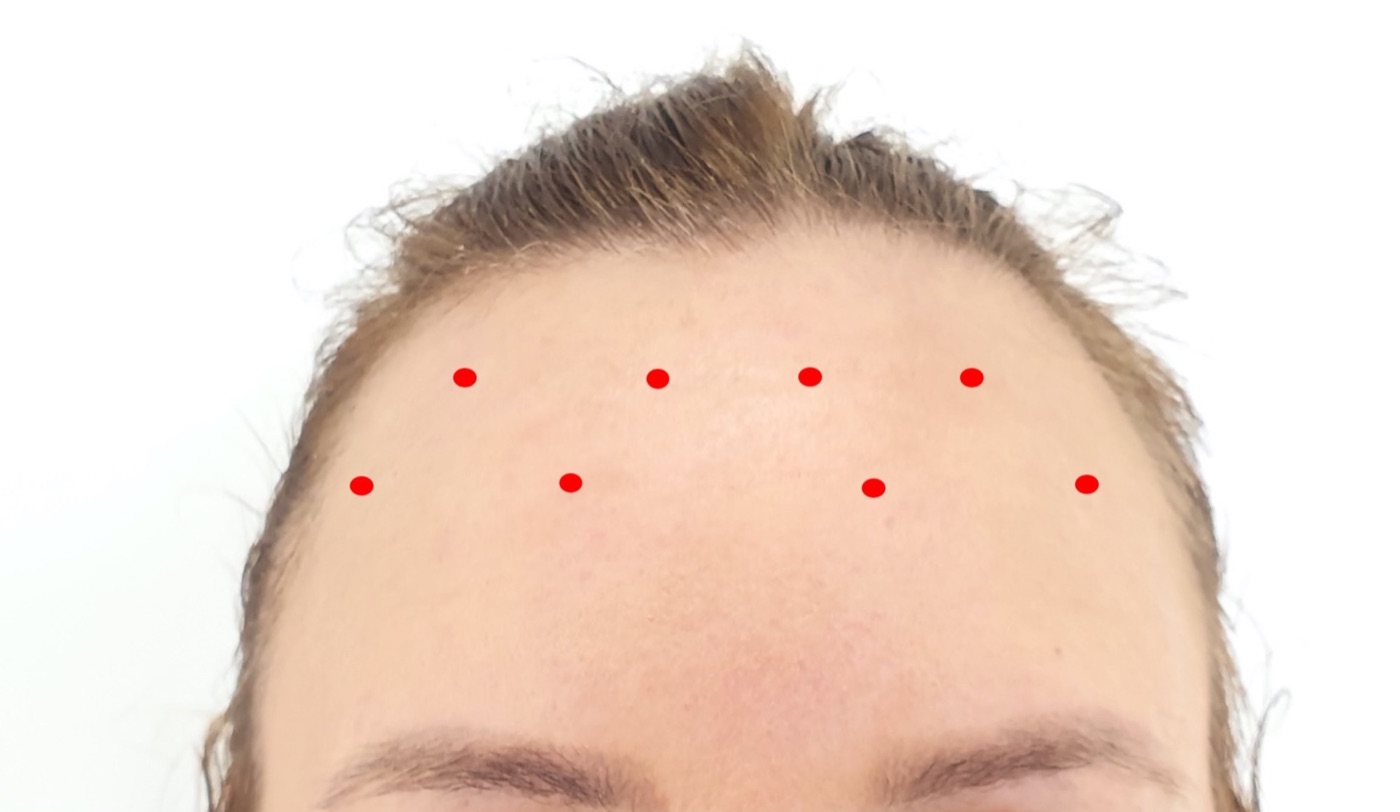
Forehead with eight red dots marking the injection points, four per side in two rows
Figure 1. The eight injection points (four per side) in a study participant. Note all points sit in the upper half of the forehead, above the brow‑elevator segment. Reproduced from Davidovic et al. 2021, Wiley, for educational discussion.
Flynn TC et al. Dermatol Surg 2008 (validated scale)Methods

Depth was verified, not assumed

Methods · ultrasound
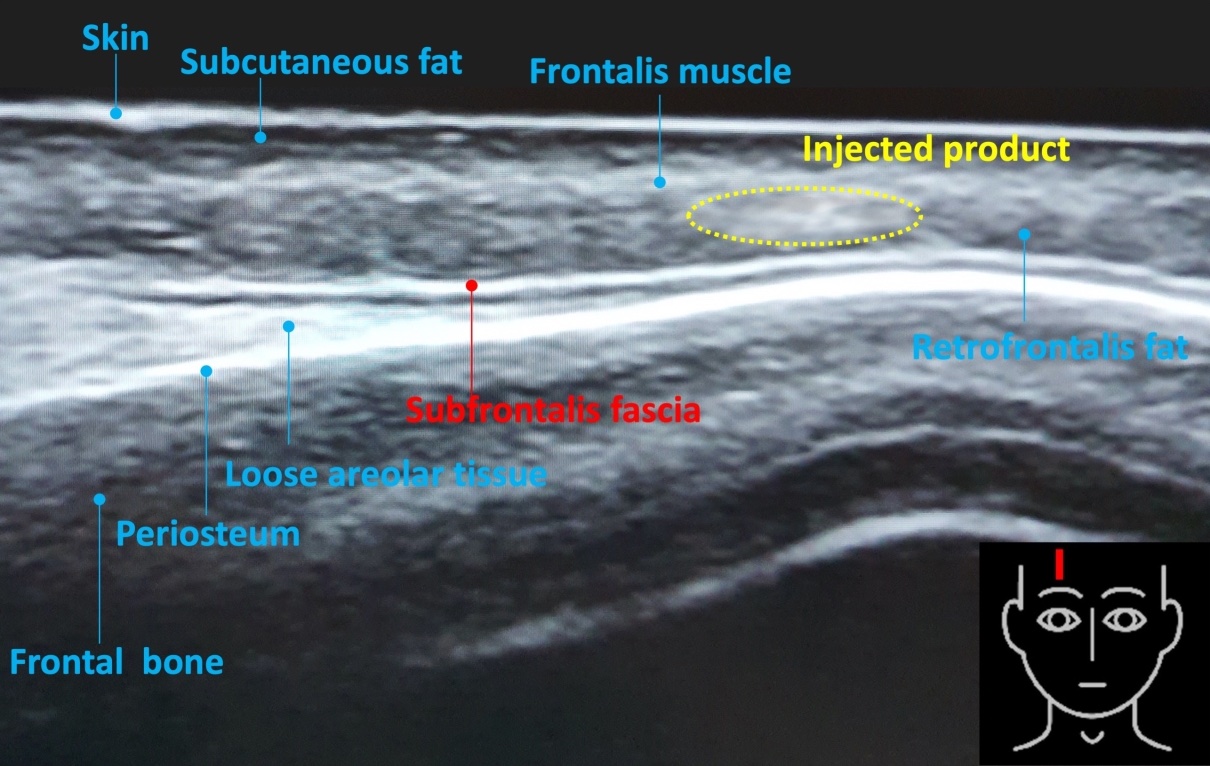
Ultrasound of forehead showing injected product in subcutaneous fat above the frontalis
Figure 2. Superficial control injection. Product (yellow) in the subcutaneous fat, superficial to frontalis. The bright line below the muscle is the subfrontalis fascia, untouched.
Ultrasound of forehead showing injected product in the loose areolar plane beneath the subfrontalis fascia on bone
Figure 3. Deep control injection. Product sits in the loose areolar tissue on the periosteum, deep to the subfrontalis fascia. Same ≈4 mm of tissue, very different compartment.
Images reproduced from Davidovic et al. 2021 (Wiley) for journal club discussionMethods
Part 3

Results

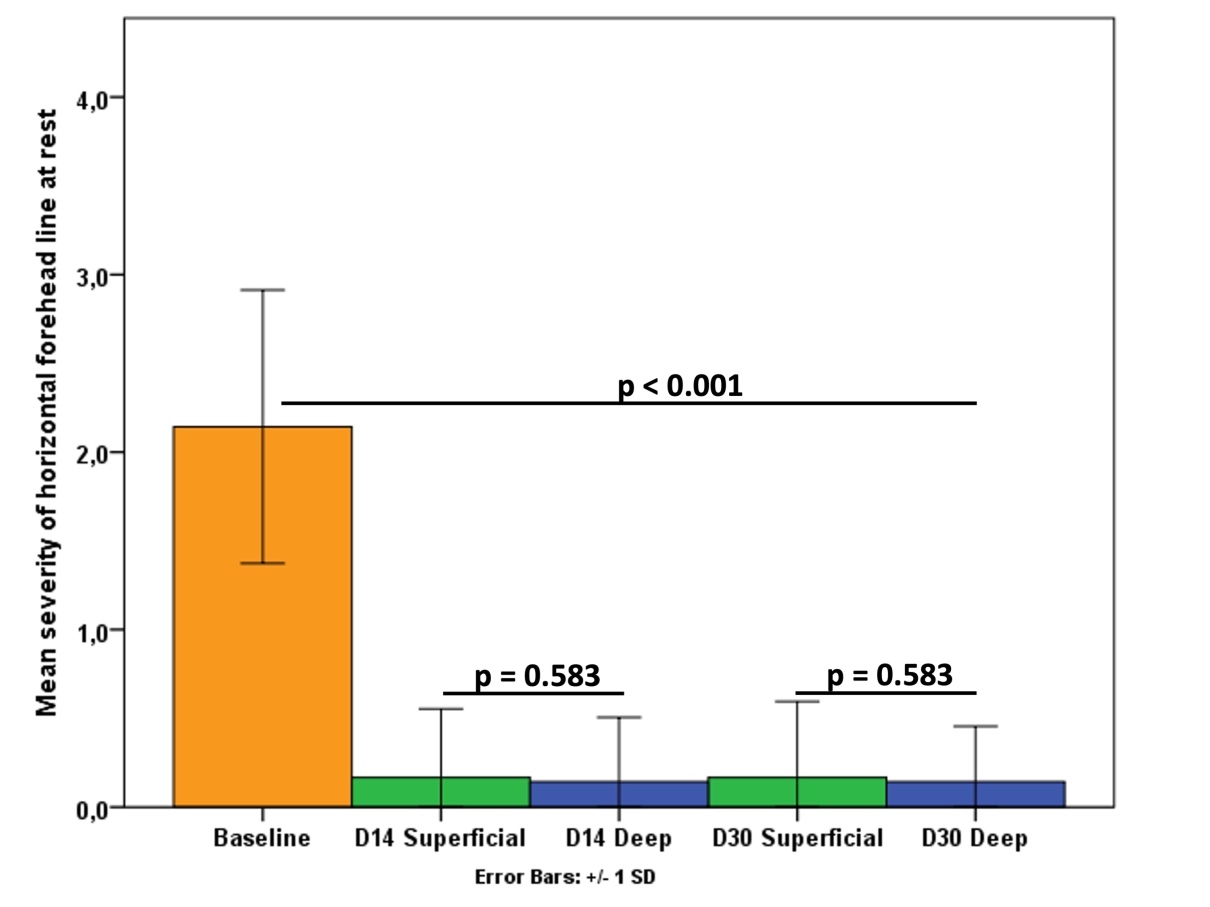
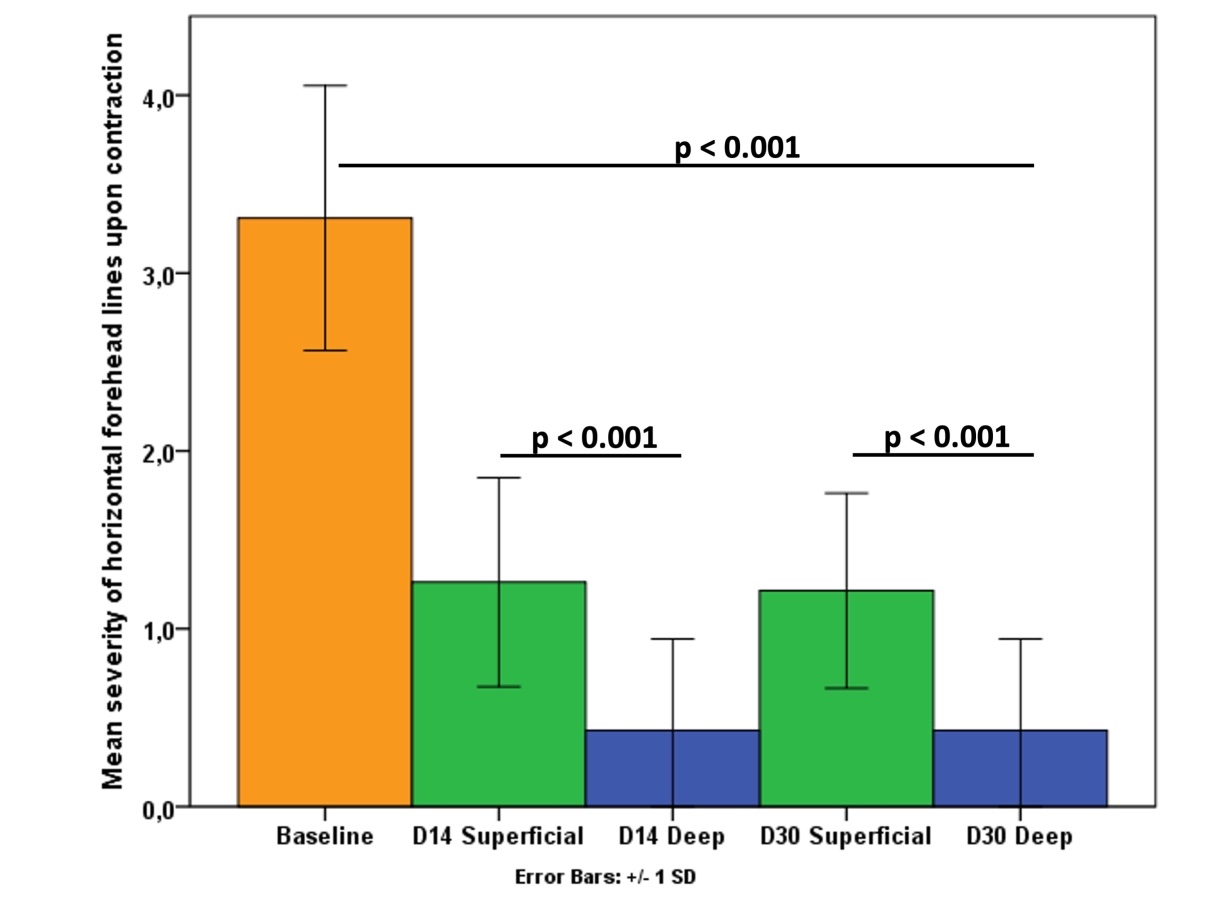
At rest, a tie. On contraction, deep wins by a wide margin, at both visits, in the eyes of all three raters.

Line severity, 0 to 4 (lower is better)

Results
Timepoint · stateSuperficialDeepp (Wilcoxon)
Baseline · rest2.14 ± 0.8—
Baseline · contraction3.31 ± 0.7—
Day 14 · rest0.17 ± 0.40.14 ± 0.40.583
Day 14 · contraction1.26 ± 0.60.43 ± 0.5< 0.001
Day 30 · rest0.17 ± 0.40.14 ± 0.30.583
Day 30 · contraction1.21 ± 0.60.43 ± 0.5< 0.001

Every injection, either depth, improved lines vs baseline (p < 0.001). Mean forehead thickness 4.01 ± 0.8 mm, no sex difference (p = 0.088).

0.43 vs 1.2contraction score, deep vs superficial, stable from day 14 to day 30. Roughly a 3‑fold difference in residual dynamic lines.
ICC 0.942agreement across the treating physician and two blinded photo raters for all ratings; 1.00 for the deep side on contraction at both visits.
0 ptosisno brow ptosis and no eyelid ptosis observed on either side through day 30 (observed, not formally measured).
Davidovic et al. 2021 · ResultsResults

Figures 7 and 8

Results
Bar chart of forehead line severity at rest: baseline about 2.1, then about 0.15 for both superficial and deep at day 14 and day 30
At rest. Both techniques flatten resting lines to near zero. Orange = baseline, green = superficial, blue = deep.
Bar chart of forehead line severity on contraction: baseline about 3.3, superficial about 1.2, deep about 0.4 at both day 14 and day 30
On maximal contraction. The superficial side still makes lines (≈1.2); the deep side barely does (≈0.4). The gap is identical at days 14 and 30.
Error bars ± 1 SD · reproduced from Davidovic et al. 2021Results

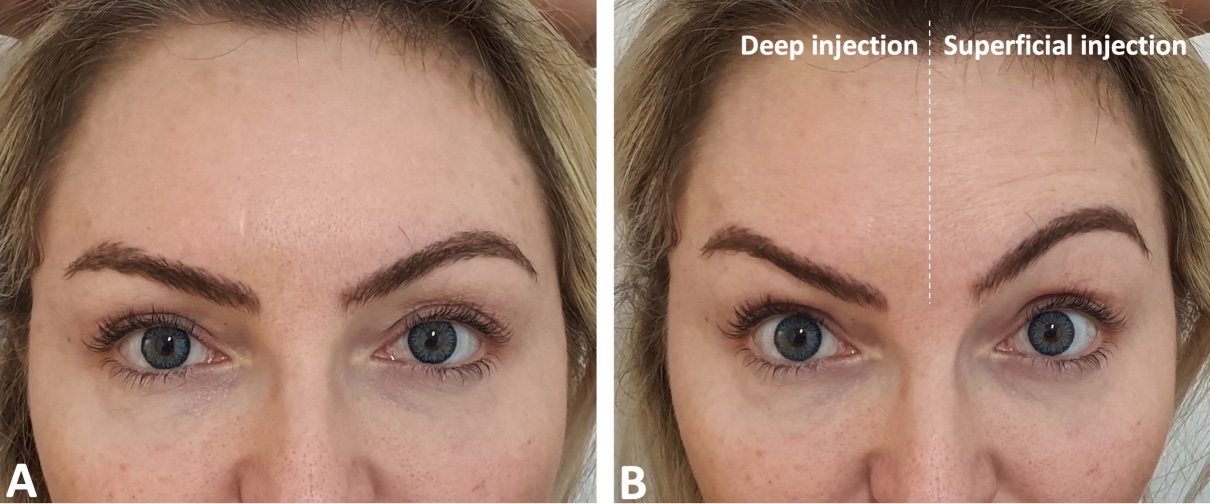
What it looks like

Results · one participant
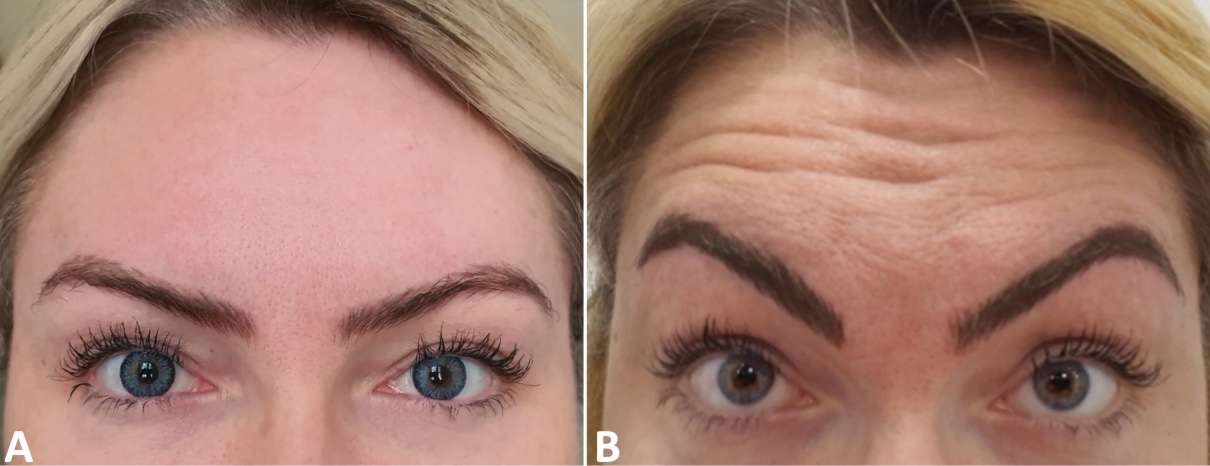
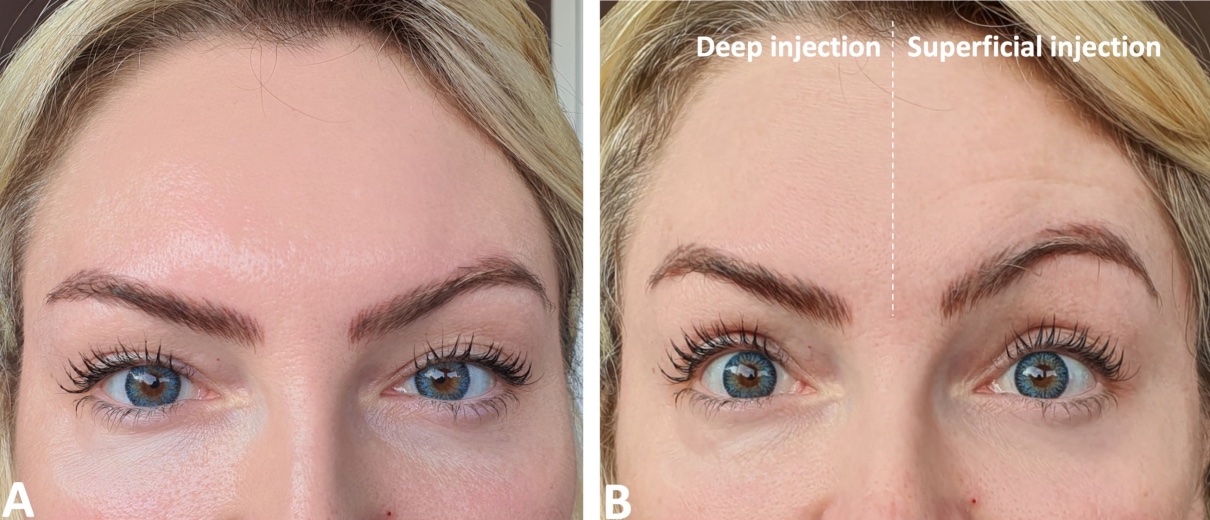
Baseline photos of a participant at rest and with deep horizontal forehead lines on maximal frontalis contraction
Baseline. At rest (A) and maximal contraction (B).
Day 14 photos: on contraction the deep-injected side is smooth while the superficial side shows lines and a raised lateral brow
Day 14. On contraction (B) the deep side (viewer's left) is smooth. The superficial side still lines, and the brow hyper‑elevates laterally: a Mephisto sign.
Day 30 photos: same asymmetry persists with Mephisto sign on the superficial side
Day 30. Same picture. The Mephisto sign is the authors' tell that frontalis is still working under the superficial side.

What to look for

  • At rest (A panels) the two sides are indistinguishable at both visits, matching the p = 0.583 result.
  • On contraction (B panels) the superficial half still forms lines and recruits the lateral brow upward. The deep half is quiet.
  • A Mephisto sign after a uniform dose tells you the lateral frontalis got less toxin than the medial, here because of depth, not units.
Figures 4 to 6, reproduced from Davidovic et al. 2021Results
Part 4

Why would depth matter for a liquid?

The authors' mechanistic argument, and whether it holds up.

The authors' explanation

Discussion

Superficial: a sheet in the way

  • Product lands between dermis and the intact suprafrontalis fascia.
  • The needle never crossed the fascia, so there is no canal into the muscle.
  • Toxin spreads ~1 cm laterally within the fat but must diffuse through fascia to reach motor endplates. Partial blockade results.
  • Resting lines still vanish because resting tone is easier to quiet than maximal recruitment.

Deep: a canal through every layer

  • Perpendicular pass perforates skin, fat, both fasciae and the muscle itself, ending on bone.
  • Water‑like, low‑G′ product tracks retrograde up the injection canal, bathing the muscle belly directly.
  • This retrograde spread was shown first for forehead filler (Cotofana 2017), and a perpendicular needle increases it versus a 10° approach (OR 10.0, 95% CI 7.1‑14.1).
  • Net effect: the muscle gets the dose, not the fat.
"The same amount of neurotoxin in the same anatomic location can have different effects when injected superficially or deep."Davidovic et al. 2021, Discussion
Refs 12‑17 in the paper: forehead compartment anatomy and filler‑spread cadaver studies from the same labDiscussion

Reconciling with the "intradermal is safer" literature

Synthesis

Jun 2018 and Kim 2020 said

Intradermal gives the same wrinkle result with less brow drop. Framed as fewer adverse events.

Davidovic 2021 says

Superficial gives the same resting result but less frontalis blockade on contraction. Framed as reduced efficacy.

Both are true

A preserved brow and residual contraction are the same finding seen from two sides. Depth is a dial on how much frontalis you switch off, not a right or wrong.

The authors' clinical rule

  • Below the C‑line (brow‑elevator segment): if you treat at all, go superficial. You want a surface effect on lines without taking the brow lift away.
  • At or above the C‑line (≈60% of forehead height and up): go deep when you want real frontalis relaxation. This is where deep is safest for the brow.
  • Toxin dosing "cookbooks" that specify units and points but not depth are leaving out a variable that changed the contraction score three‑fold here.
Cotofana et al. PRS 2020 (C‑line) · Davidovic et al. JCD 2021Synthesis
Part 5

Critical appraisal

Strong design for its size. Several things it cannot tell us.

Strengths and limitations

Appraisal

Strengths

  • Split‑face removes between‑patient confounders (age, sex, thickness, dose). Each forehead is its own control.
  • Depth verified by ultrasound, not just by feel.
  • Two blinded photo raters plus the injector; ICC 0.94 is excellent agreement.
  • Validated 0‑4 scale, graded in both rest and contraction states (the contraction state is where the signal lives).
  • Effect size is large and consistent at two visits. p < 0.001 with n = 14 is not a fragile result.
  • No industry funding.

Limitations

  • n = 14, single injector, single center, young and thin (BMI 21.9), Fitzpatrick I‑III only.
  • 30‑day follow‑up. No data on duration, which is the thing patients ask about and the thing the Toxins 2025 panel claims superficial injection shortens.
  • Brow position was not measured, only "not observed." The safety half of the question is unanswered here.
  • Split‑face midline cross‑contamination is possible with four points per side and a product that spreads ~1 cm.
  • Only abobotulinumtoxinA. Spread characteristics differ across products; the "superficial means partial" result may not transfer identically to ona‑ or inco‑.
  • Treating physician was unblinded and graded live. The blinded raters only had photographs.
  • "Superficial" here is a subcutaneous bleb, not the intradermal wheal of Jun and Kim; cross‑study comparisons are approximate.
  • No patient‑reported outcomes, no pain scores, no touch‑up data.
Davidovic et al. 2021Appraisal

What the experts are doing (AAD corpus)

Practice today
"I like now doing one injection point where I go deep, low, and then trail off as you come superficially and try to hit the entire muscle with botulinum toxin… laterally [stay] superficial, you don't want to be near that supraorbital foramen."Maria Fernanda Tembra, MD · AAD 2025 · S046 Complications of Cosmetic Procedures
"The frontalis fibers come underneath the lateral corrugator. If you're going to make that injection, you want to do it very superficially."Susan Weinkle, MD · AAD 2024 · C013 Botulinum Toxin: Video Instruction and Live Panel
"I did put toxins superficially, about two units up on the upper forehead, staying very high because this lady is highly likely to drop her brows."Ronda Farah, MD · AAD 2025 · S067 (FFA patient with brow‑ptosis risk)

Expert roundtable, Toxins Dec 2025

de Sanctis Pecora, Kerscher, Muniz, Trindade de Almeida (Merz‑sponsored session)

  • Cites this paper as the evidence that deep wins on efficacy.
  • Their rule: intradermal when partial paralysis is the goal (actors, older patients with laxity, thin skin), accepting shorter duration; intramuscular for younger patients and strong frontalis.
Transcripts from the SLU AAD lecture corpus; Toxins 2025;17(12):603, PMID 41441638Practice

How I would apply this on Monday

Takeaways
  1. Mark the C‑line first. Have the patient raise their brows; find the line where upper‑forehead skin moving down meets lower‑forehead skin moving up (usually the 2nd line from the top, ~60% of forehead height).
  2. Above the C‑line, go to bone and feel the click. Perpendicular needle, no bleb. This is where you want full frontalis effect and the brow is safe.
  3. Below the C‑line, stay superficial or skip. Small subdermal blebs give a surface effect on lines while leaving the brow‑elevator fibers working. In low‑brow or heavy‑lid patients, consider not treating this zone at all.
  4. Expect a superficial zone to look "under‑done" on animation. That is the design, not a failure. Counsel at the first visit so the 2‑week check is not a touch‑up negotiation.
  5. Chart the depth, not just the units. If a patient's result changes between visits, depth is the variable we never write down.

Caveats before adopting wholesale

  • Dysport only, 30 days only. We do not know duration or the brow trade‑off from this trial.
  • Deep bone contact is uncomfortable; the authors avoided firm plunger pressure on periosteum.
  • Lateral, low forehead: supraorbital and supratrochlear neurovascular bundles. Deep means above the C‑line, not everywhere.
  • For the forehead, "intradermal microdroplet" and "subcutaneous bleb" are different techniques with different evidence.
Journal club synthesis, not a guidelineTakeaways

Questions for the group

Discussion
  1. Do you consciously change depth across the forehead today, or do you use one depth and vary the units?
  2. Is a residual contraction score of ~1.2 (mild lines on animation) a problem for your patients, or is it the natural look many of them ask for?
  3. Would you expect the deep‑side advantage to translate into longer duration, as the Toxins panel assumes, or just a fuller peak effect?
  4. How should we handle a patient who returns at two weeks with asymmetric animation after mixed‑depth treatment: add units superficially, or convert to deep?
  5. Should "injection depth" become a required field in our cosmetic procedure note?
Cosmetics Journal Club · SLU DermatologyDiscussion

References

Sources
  1. Davidovic K, Melnikov DV, Frank K, et al. To click or not to click — the importance of understanding the layers of the forehead when injecting neuromodulators — a clinical, prospective, interventional, split‑face study. J Cosmet Dermatol. 2021;20(5):1385‑1392. PMID 33251687.
  2. Cotofana S, Freytag DL, Frank K, et al. The bidirectional movement of the frontalis muscle: introducing the line of convergence and its potential clinical relevance. Plast Reconstr Surg. 2020;145(5):1155‑1162. PMID 32332530.
  3. Jun JY, Park JH, Youn CS, Lee JH. Intradermal injection of botulinum toxin: a safer treatment modality for forehead wrinkles. Ann Dermatol. 2018;30(4):458‑461. PMID 30065587.
  4. Kim YJ, Lim OK, Choi WJ. Are there differences between intradermal and intramuscular injections of botulinum toxin on the forehead? Dermatol Surg. 2020;46(12):e126‑e131. PMID 32205751.
  5. Bravo BSF, de Melo Carvalho R, Penedo L, et al. Applied anatomy of the layers and soft tissues of the forehead during minimally‑invasive aesthetic procedures. J Cosmet Dermatol. 2022;21(11):5789‑5796. PMID 35634970.
  6. Cotofana S, Mian A, Sykes JM, et al. An update on the anatomy of the forehead compartments. Plast Reconstr Surg. 2017;139(4):864e‑872e. PMID 28350656.
  7. de Sanctis Pecora C, Kerscher M, Muniz M, Trindade de Almeida A. Why, when, and how to treat dynamic forehead lines with botulinum toxin type A. Toxins. 2025;17(12):603. PMID 41441638.
  8. Almashali M, Almutairi RR, Shadid A. Intramuscular versus intradermal botulinum toxin for forehead wrinkles: a review of side effects and efficacy. Dermatol Rep. 2024;16(1):9799. PMID 38585495.
  9. Frank K, Assemi‑Kabir S, Alfertshofer MG, et al. Electrophysiologic frontalis muscle response following neuromodulator injections. Facial Plast Surg Clin North Am. 2022;30(2):193‑199. PMID 35501060.
  10. AAD Annual Meeting transcripts: Tembra MF, S046 (2025); Weinkle SH, C013 (2024); Farah RS, S067 (2025). SLU Dermatology AAD lecture corpus.

Figures 1‑8 are reproduced from reference 1 (© 2020 Wiley Periodicals LLC) solely for non‑commercial resident education and discussion.

deeptoxin.fsahmad.comEnd